Agentic Network Operations: From NOC Fault to Booked Technician
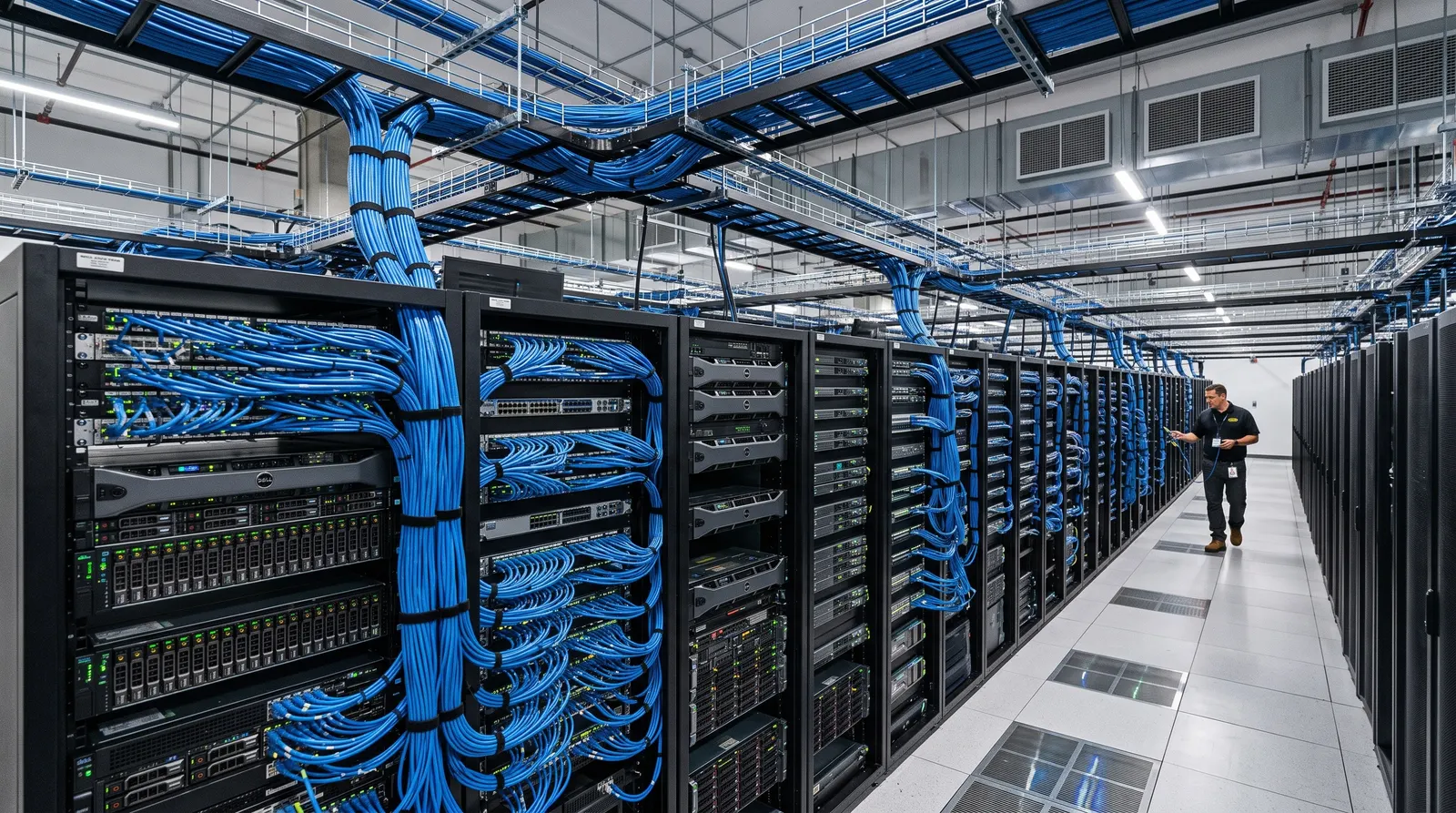
Agentic network operations is easiest to understand through one fault on one night. What follows is an illustrative scene, not a real event or a measured result: a regional fibre and fixed-wireless operator, a link down on its aggregation ring, and two AI agents owned by two organisations working the fault from alarm to booked field technician.
The Moment
It is 02:47 at the operator's network operations centre. A link down alarm fires on an aggregation router feeding four towns in the north of the region. Inside a minute, more than a hundred alarms follow: loss of signal on the optical interface, BGP sessions dropping, a cluster of fixed-wireless base stations reporting backhaul loss, and a wave of customer premises equipment going unreachable.
The NOC shift lead is the only senior engineer in the room. She has an SLA clock running on an enterprise customer's circuit in the region and a planned maintenance window on the core at 04:00. Her question is the one every shift lead asks: is this one fault or many, can we fix it from here, and if not, how fast can we get a field technician on site?
I am Harry Edwards, Head of Solutions Engineering at StudioX, and this is how that question gets answered when the NOC agent and the field-service agent can talk to each other.
What Used to Happen
On the manual path, the shift lead's first twenty minutes go to alarm correlation. She scrolls the alarm list, groups what looks related, and opens the topology view to work out which alarm is the root cause and which are symptoms.
Next comes remote diagnostics. She logs in to the router, checks optical receive levels on the ring interface, looks at the far end, and confirms there is no light. A port bounce changes nothing. That rules out a remote fix: this is physical, probably a fibre cut or a failed optic, and it needs a truck roll.
Then the handoffs start. She opens a trouble ticket. The field-service organisation, a separate company on its own dispatch platform, does not read that system, so she emails the dispatch desk and phones the on-call dispatcher to make sure it was seen. The dispatcher re-keys the site, equipment and priority into the dispatch platform and looks for a field technician with fibre-splicing skills near enough to make the SLA.
Much later the dispatcher calls back with a name and an arrival window, which the shift lead copies into the ticket by hand before checking whether the 04:00 maintenance window must move. Every step was correct; most of the time went to people waiting for each other.
What Happened Instead
In the agentic version of the same night, the NOC runs a StudioX mission for fault handling, and the field-service organisation runs its own dispatch agent on its own platform. The two agents talk over the Agent2Agent protocol. If A2A is new to you, start with What Is the Agent2Agent (A2A) Protocol?. StudioX supports A2A 1.0.
Trigger. The link down alarm and the burst that follows reach the NOC agent through the operator's event manager. The agent reads alarms, topology and performance data through MCP tools.
Alarm correlation and root cause. The NOC agent groups the burst against the topology: every downstream alarm sits behind one ring interface on one aggregation router. It marks that interface as the probable root cause and the rest as symptoms, and opens a trouble ticket with the correlated set attached.
Remote diagnostics. The agent runs read-only diagnostics allowed by the operator's Agent Policies: optical receive levels, interface counters, the far-end state. No light on either side of the span. A port reset is also on its allowed list, and it tries one. The link stays down. The agent records its conclusion on the ticket: physical fault on the span, remote fix ruled out, truck roll required.
Reading the Agent Card. Dispatch belongs to the field-service organisation, so the NOC agent does not try to book a technician itself. It reads the field-service agent's Agent Card. The card describes a skill for accepting network fault dispatches, the content it accepts (text plus structured fault data), that it supports streaming updates, and that it requires OAuth 2.0. The operator's team had tried this agent from the A2A playground in Studio before letting the mission rely on it.
Sending the task. The NOC agent sends a message to the field-service agent. Its parts carry the site identifier and address, the equipment and interface, the probable fault type, the spares likely needed, the customer SLA tier and the 04:00 maintenance window as a constraint. The task enters the submitted state, then working.
What happens on the other side. The NOC agent cannot see inside the field-service agent, and does not need to. That agent checks technician skills, location and on-call status, and the stock of spares in the nearest depot, against its own rules. Partway through, the task moves to input-required: it asks whether site access needs an escort at the aggregation cabinet. The NOC agent answers from the site record, and the task returns to working.
The artifact. The task completes with an artifact: a booking reference, the assigned field technician's crew identifier, a dispatch window with an estimated arrival, and confirmation that a replacement optic and a splicing kit are on the van.
What the NOC agent did with it. It writes the booking into the trouble ticket, links the correlated alarms, and calculates the restoration estimate against the enterprise customer's SLA. The estimate falls inside the 04:00 maintenance window, so the agent proposes deferring the core work by one window.
Where a person decided. Moving a planned maintenance window is a change that the operator's policy reserves for a person. The mission pauses at that step for human approval. The shift lead sees the ticket, the correlation, the diagnostics, the booking and the proposal in one view. She approves and sends the customer update herself.
Outcome. The shift lead spent her time on two decisions rather than on phone calls and re-keying, and the field technician is on the road.
Why It Worked: The Architecture Under Agentic Network Operations
Two agents, two owners, two platforms. The operator owns the NOC agent and its access to network systems. The field-service organisation owns the dispatch agent, its technician roster and its depot stock. Neither gave the other credentials to its systems; the NOC agent could send a dispatch task, never edit the dispatch schedule.
The Agent Card. Discovery was not a hard-coded integration. The field-service agent described what it does, what it accepts and how to authenticate, and the NOC agent worked from that description.
The task lifecycle. A dispatch is not an instant API response. The task moved through submitted, working and input-required before it completed, with updates streamed back. A plain tool call would have been the wrong shape for that.
Policy and approval. Every tool call the NOC agent made, from reading optical levels to resetting the port, was checked against the operator's Agent Policies (Open Policy Agent, Rego) before it ran, and each allow or deny was logged. Changing the maintenance window was set as a human approval step, so the mission paused until the shift lead decided.
The provenance record. After the fault, the operator can download a W3C PROV provenance record for the run: which agent or person acted, what data it used and what it produced.
StudioX publishes its assistants and missions as A2A agents through the A2A gateway at /a2a, each with its own Agent Card, so the pattern also runs the other way: a partner's agent can send tasks to an operator's StudioX mission. More on how StudioX supports network teams is at https://www.studiox-ai.com/networkx.
What This Pattern Generalizes To
The same handoff shape applies to other boundaries inside network operations:
- NOC to a transport or dark-fibre provider. When alarm correlation places the root cause on a leased span, the NOC agent hands the fault to the provider's agent and gets back a provider ticket reference and an estimated restoration time.
- NOC to the change management team's agent. A recurring fault that needs a planned fix becomes a request for a maintenance window, with the change team's agent checking conflicts and returning a proposed slot for a person to approve.
- Field technician back to the NOC. When the field technician closes the job, the field-service agent sends a task to the NOC agent to verify restoration with remote diagnostics before the trouble ticket closes.
Frequently Asked Questions
What if the field-service organisation does not support A2A?
Then the handoff falls back to whatever exists today: a ticket integration, an email or a phone call. A2A only works when both sides speak it. Test any agent a partner offers from the A2A playground before relying on it.
Can the NOC agent book a truck roll without a person?
Only if the operator decides it may. Teams set which actions an agent can take on its own and where a person must approve. Many operators will let the agent request a dispatch for a confirmed physical fault and keep changes to maintenance windows, customer communications or high-cost dispatches as approval steps.
Does this work in an isolated network management environment?
StudioX can be deployed air-gapped. In that case an A2A handoff depends on both agents being reachable inside the isolated environment, so the deployment plan has to account for where each agent runs and which models, identity services and data sources it depends on. A field-service agent hosted outside that boundary would not be reachable.
Call to Action
If your NOC spends its nights correlating alarms and phoning dispatch, map one handoff first: the fault types where a truck roll is certain and the partner who receives them. Then look at how agentic network operations runs on StudioX at https://www.studiox-ai.com/networkx, and talk to our solutions engineering team about a pilot on one region.
Related Reading
Discussion
No comments yet — start the conversation.