Machine Learning at IoT Scale: Lessons from the Global IoT Conference
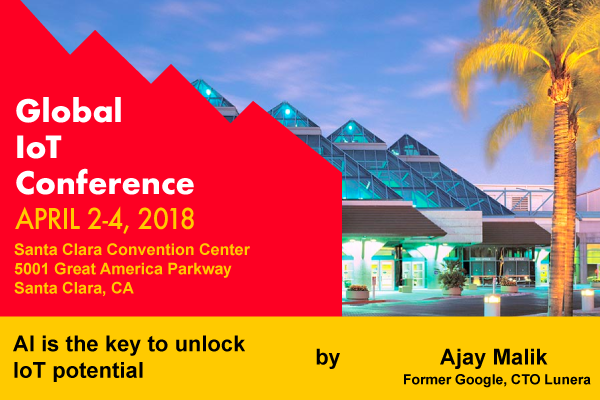
The room in Santa Clara
In the spring of 2018 I stood in a packed side hall at the Global IoT Conference in Santa Clara. The main stage that year was all about connectivity — new radios, new gateways, new cloud back ends to swallow the exhaust of billions of sensors. My session was smaller and, honestly, a little contrarian. The abstract I had submitted asked a blunt question: if you are shipping machine learning to millions of connected devices, how do you train and serve those models without drowning in the very data you worked so hard to collect?
The audience was the people who actually had to answer that question — platform architects from industrial firms, a couple of automotive teams, engineers from building-automation vendors, and a scattering of folks doing agriculture and logistics. These were not researchers. They were operators. They had fleets in the field already, and the fleets were only getting bigger.
I opened with a number that got a nervous laugh. A single mid-sized industrial deployment I had looked at was generating more raw telemetry per day than the team could afford to move to the cloud in a month. The data was winning. That was the whole talk in one sentence.
The argument: bring the model to the data
The reflex in 2018 was to centralize. Stream everything to a data lake, train a big supervised model on GPUs, and push predictions back down. For a recommendation system or a fraud model, fine. For a fleet of vibration sensors on pumps in a refinery, that architecture quietly falls apart. Bandwidth is metered, links are flaky, and latency matters when the thing you are predicting is a bearing about to seize.
So my argument was simple and, at the time, still a little unfashionable: stop assuming the model lives in the cloud and the device is dumb. Treat training and serving as a distributed problem. Serve inference at the edge where the decision has to be made, train centrally where you can afford the compute, and be ruthless about what actually needs to travel between the two.
I walked through a layered picture I had been sketching for months. At the bottom, devices run a compressed model and do the inference locally — a quantized neural network, or often something far simpler like a gradient-boosted tree that fits in a few hundred kilobytes. In the middle, gateways aggregate, filter, and do the first pass of anomaly detection so that only interesting events climb higher. At the top, the cloud does the heavy supervised training, holds the labeled history, and periodically ships new model versions down.
The key insight I kept hammering: most of your telemetry is confirmation that nothing is wrong. You do not need to move it. You need to move the surprises. Design the edge to decide what is surprising, and your data problem shrinks by one or two orders of magnitude.
Why it mattered to enterprises then
In 2018 the enterprise conversation about machine learning was still maturing. Plenty of teams had a data-science group producing accurate models in notebooks, and almost none of them had a clean story for getting those models into production and keeping them healthy. The term MLOps was just beginning to circulate. The hard part was never fitting the model; it was the plumbing around it — versioning, monitoring, retraining, and rolling out updates without bricking a device you cannot physically reach.
For IoT that gap was brutal. A model that is 96 percent accurate in the lab can drift badly once it meets a real factory floor, a new sensor batch, or a season change. If your only way to fix drift is a full firmware flash across a hundred thousand devices, you will not fix it often. So I argued for treating the model as a separately deployable, separately versioned artifact — something you could update on its own cadence, canary to a small slice of the fleet, watch, and then widen. That was operational maturity, not glamour, and it was exactly what most teams were missing.
A concrete example
I told a story about predictive maintenance on rotating equipment, because it was the cleanest example I had. Picture a few thousand pumps, each with an accelerometer sampling vibration at high frequency. Raw, that is a firehose. Nobody can stream continuous high-rate vibration to the cloud from thousands of assets and stay solvent.
The design we landed on did almost all the work locally. On each device, a small supervised model — trained centrally on labeled failure histories — scored short windows of vibration and emitted only a health estimate plus the rare flagged window. Gateways collected those health estimates, did incremental online updates to a local baseline so the system adapted to each site's normal, and only escalated genuine anomalies. The cloud saw a trickle: labeled anomalies and periodic samples used to retrain. When a new failure mode showed up at one site, we labeled it, folded it into training, and pushed an updated model to the whole fleet within days.
The result was not a fancier model. It was a system where the model in production kept getting better without the data volume ever getting out of control. That was the point I wanted the room to leave with: at IoT scale, the architecture around the model matters more than the model.
The bridge to today
Those principles — models running in production, learning continuously from what the field teaches them, and making decisions you can actually explain and trust — did not go out of date. If anything they became the foundation. At StudioX we now operationalize exactly that discipline as autonomous AI workers and AI Missions: durable systems that act, observe their own outcomes, and improve, with humans able to see why each decision was made. The 2018 tools were humbler, but the engineering values were the same ones we build on now.
Related on StudioX: Enterprise AI Platform · AI Workers · AI Missions
Discussion
No comments yet — start the conversation.