Is TIME Magazine Going to Pick the Drone Bomber as the Machine of the Year?
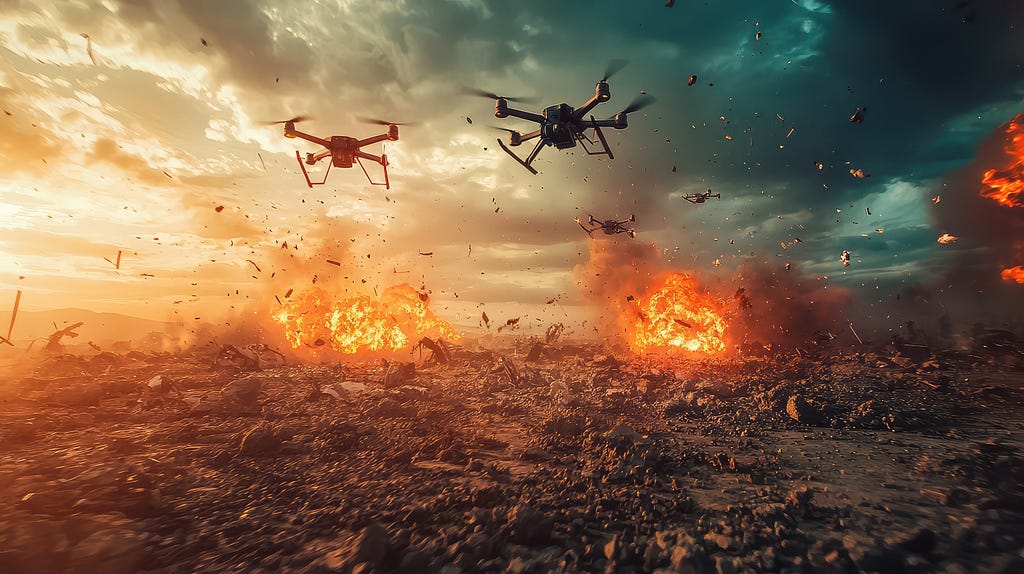
From creativity, progress, and possibility… to distance, disconnection, and destruction.
In 1983, Time magazine named the Personal Computer its “Machine of the Year.” It wasn’t a person or a politician — it was a machine that redefined how humans connected. It symbolized creativity, progress, and possibility.
But if Time were honest in 2025, the cover machine might not be a computer at all. It would be a drone bomber. Not a tool of connection, but a machine that embodies distance, disconnection, and destruction.
The Drone Reality of 2025
Across the globe, drones have gone from novelty to necessity in warfare. Unlike fighter jets or tanks, they’re cheap to produce, easy to launch, and devastating in their impact.
Ukraine & Russia
Russia has turned Iranian-designed Shahed drones into a weapon of saturation. Between August 2024 and March 2025, Ukraine recorded 15,011 Shaheds launched; only 454 hit their targets (~3%), while 9,051 were shot down [1]. In March–May 2025, another 7,974 drones were launched, with 999 reaching targets (~12.5%) and 4,188 destroyed in the air [2]. Launch rates climbed from 200 per week in late 2024 to over 1,000 per week by spring 2025 [3].
On one June night, Russia unleashed 407 drones and decoys, plus 40 cruise missiles and 6 ballistic missiles — a single coordinated attack that devastated Kharkiv [4]. Ukraine has responded with thousands of homemade FPV quadcopters, often costing under $500, used to disable tanks worth millions [5].
Israel & Palestine (Gaza)
Since October 2023, Gaza has endured relentless strikes. By early 2025, the Gaza Health Ministry reported over 48,000 Palestinians killed, while The Lancet estimated deaths exceeding 70,000 when accounting for indirect fatalities [6]. A Guardian investigation reported 50,000 killed since October 2023, with 69% of Gaza’s buildings damaged or destroyed [7].
Airstrikes have dropped 70,000 tonnes of explosives — more than Dresden, Hamburg, and London combined during WWII [8]. At least 87% of schools were hit or destroyed [9]. Amnesty International accused Israel of “unleashing hell,” describing the campaign as genocidal [10]. Drones are central: they hover constantly, identifying and striking in seconds.
India & Pakistan
In May 2025, Pakistan launched 300–400 drones across 36 border locations, including Rajasthan and Punjab [11]. India claimed to neutralize over 400 drones in Rajasthan alone [12]. The surge triggered a regional arms race: India tripled UAV spending to $470 million in 2025 [13].
Here, drones escalate tension between nuclear rivals. Each incursion forces military response, raising the risk of escalation over machines that cost less than a truck.
Sudan
Sudan’s civil war has become a drone war. Since April 2023, over 16,650 people have been killed [14], and 12.3 million displaced — the largest displacement crisis worldwide [15]. The Rapid Support Forces (RSF) have used Chinese-built drones to strike hospitals, water facilities, and cities once considered safe.
In January 2025, an RSF drone hit the Saudi Maternal Hospital in El Fasher, killing 70 civilians and injuring 100 [16]. Over 70% of Sudan’s hospitals are non-functional, and cholera outbreaks loom [17]. Humanitarian agencies warn the death toll, including starvation and disease, may exceed 150,000 [18].
Yemen
Between 2016 and 2024, there were 426 drone incidents targeting aid and health operations, killing 21 aid workers and 73 health staff [19]. In 2024 alone, incidents tripled, making up 12% of all explosive attacks — double the year before [20].
Aid convoys and medical staff have been systematically targeted: 54% of aid-worker deaths occurred in vehicles, compared to 22% at fixed facilities [21]. For Yemenis, drones mean not only attacks on militants but destruction of humanitarian lifelines.
Afghanistan
Afghanistan remains haunted by two decades of U.S. drone strikes. While the U.S. withdrawal reduced foreign operations, the legacy persists: chronic trauma, sleepless children, and communities terrorized by the sound of buzzing overhead. Studies show widespread psychological harm from years of “living under drones” [22].
China & Taiwan
Chinese drones frequently cross into Taiwan’s airspace. In 2024, Taiwan recorded record numbers of UAV incursions, including swarms around outlying islands [23]. Though many were surveillance drones, Taipei fears swarming strikes: hundreds of drones overwhelming radar and anti-air systems.
Taiwan has accelerated defenses, deploying U.S.-supplied ALTIUS-600M loitering munitions and Switchblade 300s, while building its own domestic swarms [24]. Each drill rehearses a future drone war over the strait.
Iran
Iran has emerged as the world’s drone exporter. Shahed UAVs supplied to Russia are mass-produced locally in Russian factories, sparking tensions between the two allies over control of designs [25]. Iranian drones also arm militias in Yemen, Hezbollah in Lebanon, and groups across Africa.
For Tehran, drones are not just weapons but policy: cheap, deniable, and exportable. They extend Iran’s reach without deploying troops, making it a drone superpower.
Why Drones Matter More Than We Admit
A pilotless drone isn’t just a military asset. It changes the logic of conflict:
- No pilot risks being shot down.
- No family receives a soldier’s body back.
- No politician needs to explain coffins arriving at home.
Remote killing costs less politically, which means it can happen more often.
And as algorithms start guiding targeting decisions — autonomously selecting what to attack — we’ve stepped fully into a new era: the Drone Age [26].
The False Debate on “AI”
Corporate and academic circles obsess over “LLMs,” “AGI,” and “the race to general intelligence.” That’s not where AI’s sharpest edge is being felt.
The real beginning of AI is here already:
- Algorithms flying drones.
- Machines identifying targets.
- Autonomous systems deciding in milliseconds who lives and who dies.
This isn’t speculative fiction. It’s playing out daily over Kyiv, Gaza, Omdurman, Kashmir [27].
Conclusion: Our Cover of the Year
In 1984, the cover was a PC. It symbolized connection.
In 2025, the honest cover would be a drone. It symbolizes disconnection — our willingness to wage war without presence, without risk, without faces.
💔 It is tempting to celebrate AI as “the future.” But maybe history will record that 2025 was not the dawn of artificial intelligence as we imagined — it was the dawn of Artificial War.
References
[1] Ukrainian Ministry of Defense reports on Shahed drone attacks, 2024–2025.
[2] Institute for Science and International Security (ISIS), “Shahed-136 Deployment in Ukraine,” 2025.
[3] CSIS, “Russia’s Shahed Saturation Campaign,” 2025.
[4] Russia Matters, “Weekly Russia Review,” June 2025.
[5] U.S. Army Press, “Homemade FPV Quadcopters in Ukraine,” 2024.
[6] Gaza Health Ministry casualty reports; The Lancet, 2025.
[7] The Guardian, “Gaza Casualties Top 50,000,” March 2025.
[8] Al Jazeera, “70,000 Tonnes of Explosives Dropped on Gaza,” 2024.
[9] UNOCHA, “Education Under Fire in Gaza,” 2024.
[10] Amnesty International, “Israel’s War in Gaza Amounts to Genocide,” 2024.
[11] The Diplomat, “The First India-Pakistan Drone War,” May 2025.
[12] Times of India, “India Neutralizes 400 Pakistani Drones,” 2025.
[13] Reuters, “India Triples Drone Defense Spending,” May 2025.
[14] Amnesty International, “Sudan: Civilian Toll in Drone War,” 2024.
[15] UNHCR, “Sudan Displacement Crisis,” 2025.
[16] BBC, “RSF Drone Strike on Saudi Hospital in El Fasher,” January 2025.
[17] Reuters, “Red Cross: Sudan Hospitals Under Drone Attack,” April 2025.
[18] Le Monde, “Sudan’s Hidden Death Toll,” 2025.
[19] Insecurity Insight, “Drone Attacks on Aid Operations,” 2025.
[20] Insecurity Insight, “Hovering Threats Report,” 2025.
[21] ACLED Data, “Drone Warfare and Civilian Casualties,” 2024.
[22] Stanford/Columbia “Living Under Drones” report, 2012; UN follow-ups, 2023.
[23] Jamestown Foundation, “Chinese Civilian Drone Incursions into Taiwan,” 2024.
[24] RSIS, “Taiwan’s UAV Program and Cross-Strait Tensions,” 2024.
[25] New York Post, “Iran-Russia Rift over Drone Tech,” August 2025.
[26] U.S. Department of Defense, “AI-Enabled Drone Swarm Exercises,” 2023.
[27] Investigative conflict zone reporting (Kyiv, Gaza, Omdurman, Kashmir), 2024.
Related on StudioX: Enterprise AI Platform · AI Workers · AI Missions · Enterprise Knowledge
Discussion
No comments yet — start the conversation.