The Hidden Risk of Blind Trust in AI's Black Box
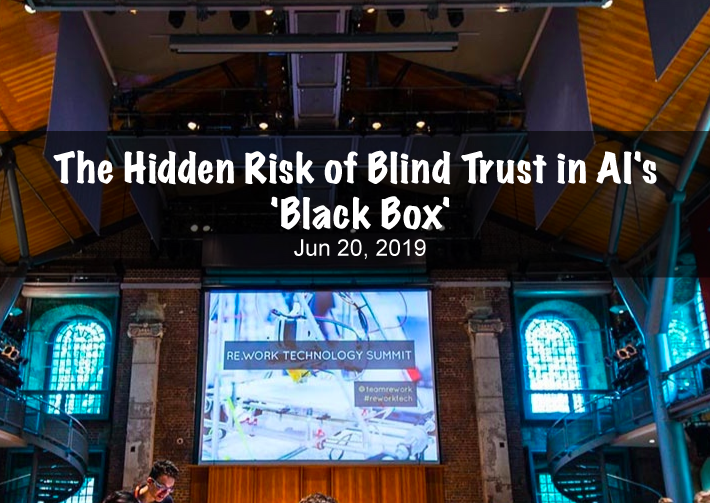
San Francisco, and a room that had stopped clapping for accuracy
By the time I spoke at the ReWork Technology Summit in San Francisco in 2019, the mood in the enterprise machine learning world had shifted in a way I found healthy. A few years earlier, a talk could get applause simply by showing a deep neural network beating a benchmark. Not anymore. The room I walked into that day — a hotel ballroom with the usual too-bright stage lighting and a crowd of practitioners, risk officers, and a few visibly skeptical people from regulated industries — had stopped clapping for accuracy alone. They had started asking a harder question: can you explain it?
That question was my whole talk. My argument was blunt, and I led with it: an enterprise cannot deploy a deep neural network it cannot explain, no matter how accurate it is — and in 2019 our ability to build accurate models had badly outrun our ability to explain them. The gap between those two curves was the most important problem in applied machine learning that year, and I wanted the room to feel it as a business risk, not an academic one.
The black box, defined honestly
I'm careful with the phrase "black box," because it's often used lazily. A deep neural network is not literally unknowable — every weight is right there, and the computation is fully deterministic. The problem is that the reason for any single prediction is smeared across millions of parameters and non-linear interactions in a way no human can read directly. You can inspect every number and still not be able to say, in a sentence, "this loan was denied because…". That is the sense in which it's a black box: not hidden, but illegible.
For a lot of machine learning that didn't matter. If a recommendation model suggests the wrong film, nobody demands a written justification. But move that same illegibility into credit, hiring, insurance, medical triage, or fraud, and it becomes intolerable — sometimes literally illegal. In Europe, people were already citing a "right to an explanation" for automated decisions. A model you can't explain isn't just risky in those settings. It's undeployable.
Accuracy is not trust
The core confusion I wanted to clear up was that accuracy and trust are different things, and enterprises had been quietly conflating them.
A model can be highly accurate for the wrong reasons. I told the room the story that everyone in that field knew — the image classifier that learned to detect a certain animal mostly by detecting snow in the background, because in its training photos that animal usually appeared on snow. It scored wonderfully on the test set. It had learned almost nothing about the animal. Accuracy on held-out data hid a model that was, in any meaningful sense, wrong.
Now transplant that failure mode into a hospital or a lending desk. A model that's 95% accurate but keys on a spurious correlate is a liability waiting to trigger. Interpretability was the only way to catch that class of error before it hurt someone, because the only tell is looking at what the model is using to decide, not just how often it's right.
The early tooling for peering inside
I spent the practical middle of the talk on the tools we actually had in 2019 to open the box a little, and I was candid that they were partial.
The most useful family was local, model-agnostic explanations — techniques that don't try to explain the whole network but instead explain one prediction at a time. The idea was to take a single decision and ask which input features pushed it which way, by probing the model with small perturbations of that specific case. Two approaches were everywhere in serious shops that year: one built a simple, interpretable approximation of the model in the tiny neighborhood around a single prediction, and another borrowed a concept from game theory to fairly attribute a prediction across its input features. Both produced something a human could read: this application was declined mainly because of these three factors. That sentence, finally, was something you could hand to a customer, an auditor, or a regulator.
For deep networks working on images, we also had saliency and attribution maps — highlighting which pixels most influenced the classification, which is exactly how the "it's looking at the snow" failures got caught. And more broadly, teams leaned on global tools like feature-importance rankings and partial-dependence plots to understand a model's overall behavior, not just single cases.
I was honest about the limits. These methods were approximations. They could disagree with each other. A local explanation could be locally faithful and still miss the bigger picture. None of them turned a deep network into something as transparent as a decision tree. But they were enough to move from "the model said so" to "the model decided this, for these reasons, and here's how we checked" — and for an enterprise, that shift was the difference between deployable and not.
Why this mattered to enterprises then
I brought it back to the people in the room who had to sign things. Interpretability in 2019 wasn't a nice-to-have; it was load-bearing for three separate reasons, and I named them.
First, regulation. Regulated decisions required a defensible rationale, and "our neural network is very accurate" was not a rationale. Second, debugging. You cannot fix what you cannot see — the snow-detector class of error is invisible until you look at the model's reasons. Third, and most underrated, adoption. The domain experts an enterprise most needed to trust a model — the underwriter, the clinician, the fraud analyst — would override any system they couldn't understand. An explanation wasn't only for the regulator. It was how you got your own best people to actually use the thing.
A concrete example: the underwriter who wouldn't switch
I closed with a case that made it human. A lender had a deep model that beat their old scorecard on every offline metric. The underwriting team refused to rely on it. Not out of stubbornness — out of professional responsibility. They could not tell a declined applicant why, and they weren't willing to put their names on a decision they couldn't articulate.
The fix wasn't a better model. It was wrapping the existing model in a local explainer so that every decision came with its top contributing factors, in plain language, on the same screen. Almost overnight the underwriters started trusting it — because now they could sanity-check each explanation against their own judgment, catch the occasional nonsense, and stand behind the rest. Same accuracy. Completely different outcome. The model didn't need to be smarter. It needed to be legible.
The short bridge to now
I won't dress up 2019 as more advanced than it was — the explanation tools were early, approximate, and often argued with one another. But the principle held and still holds: never deploy a decision you can't explain, and treat legibility as a requirement, not a courtesy. That principle — explainable decisions, models kept honest in production, learning that continues as the world changes — is exactly what StudioX now operationalizes as autonomous AI workers and Missions, well beyond the single-prediction explainers of that San Francisco stage.
Related on StudioX: Enterprise AI Platform · AI Workers · AI Missions
Discussion
No comments yet — start the conversation.