Apple Repeating Motorola’s Fatal Mistake?
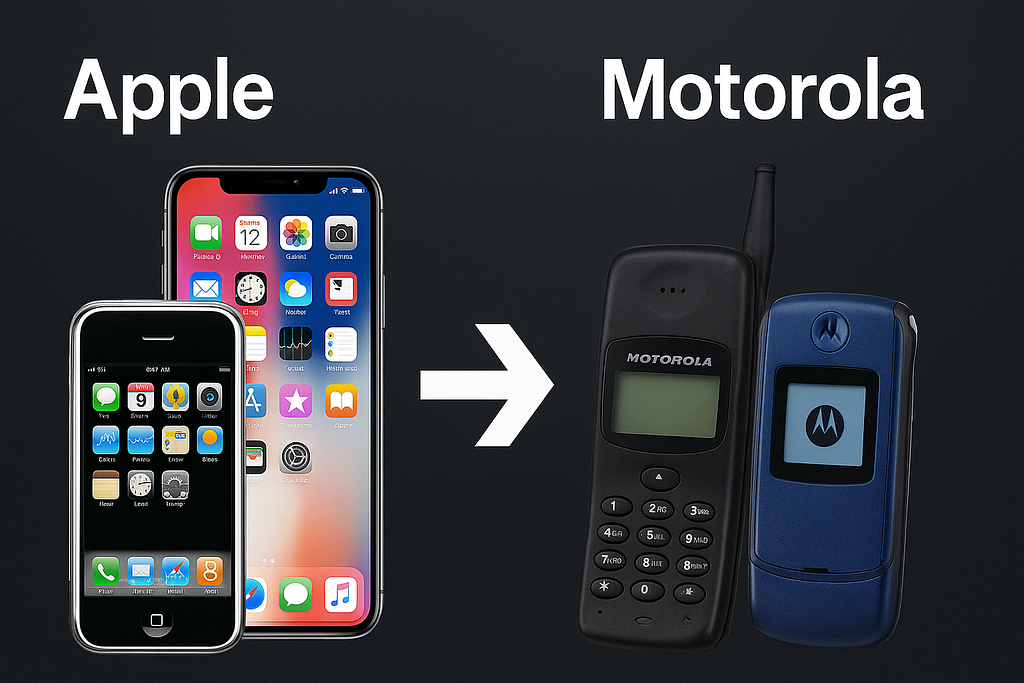
Created using ChatGPT
When Innovators Turn into Gatekeepers: The Historical Cycle of Tech Giants
In 2007, as an employee at Motorola, I witnessed a pivotal moment firsthand. Engineers, visionaries, and business strategists around me stood confident yet blind, firmly declaring the impossibility of Apple’s ambitious vision — the iPhone. With unwavering certainty, they proclaimed, “Carriers will never allow it. Apps cannot be installed openly. This vision is too bold, too unrealistic.”
Yet, hidden secretly within my pocket was undeniable proof — the original iPhone. Every instinct within me was bursting to reveal this transformative innovation to my skeptical colleagues. However, corporate policies forced my silence, branding my possession almost blasphemous. Motorola, once a pioneer of mobile technology with innovations like the StarTAC and Razr, had unknowingly started its journey toward becoming obsolete by dismissing innovation.
From Disruption to Doubt: Apple’s Crossroads
“Every big idea starts out looking impossible. Don’t let doubt drown the voice of the visionary inside you.”
Fast forward eighteen transformative years — an entire generation’s worth of technological evolution. Apple, once synonymous with revolutionary thinking and audacity, now stands at a similar crossroads. Today, Apple’s public posture around artificial intelligence has become noticeably restrained. Unlike competitors who launch bold AI products, Apple chooses a more calculated, quieter path.
They speak of privacy, ecosystem control, and a seamless experience — values that undoubtedly matter. But in doing so, they’ve also remained notably silent or slow when it comes to launching foundational, generative AI tools. Siri, once a pioneer, has been outpaced by more responsive, versatile models from OpenAI, Google, and others. Even internally, Apple has focused more on refining existing features with machine learning than delivering publicly game-changing AI experiences.
This isn’t to say Apple lacks the talent or resources. They’ve made massive AI hires, are rumored to be training large language models, and no doubt have secret projects underway. But their public posture — the story they’re telling the world — resonates not with bold disruption, but with caution and control. This echoes the kind of risk-aversion that once led Motorola to dismiss the iPhone’s potential.
🔍 The Illusion of Thinking
Apple’s research paper doesn’t mince words: when tested on structured puzzles like Tower of Hanoi and River Crossing — designed to avoid data contamination — it found that leading AI models experienced a “complete accuracy collapse” once task complexity surpassed a critical threshold. Even more striking, the models began to reduce their reasoning effort as challenges increased, despite having sufficient resources and time to complete the tasks.
This counterintuitive failure reveals a significant limitation in current AI reasoning architecture. Apple’s researchers argue this shows that today’s large reasoning models (LRMs) may not scale reliably toward Artificial General Intelligence (AGI). The paper challenges the assumption that simply increasing model size yields better general reasoning.
🔗 Read Apple’s research paper “The Illusion of Thinking” here: https://machinelearning.apple.com/research/illusion-of-thinking
Milestones That Made Apple a Giant
Consider Apple’s journey:
- 2001: The iPod revolutionizes music consumption and distribution.
- 2007: Apple shatters the status quo with the first iPhone, transforming how the world interacts with technology.
- 2008: The App Store revolutionizes software distribution, empowering millions of developers worldwide.
- 2010: Apple’s iPad redefines computing yet again, marking another massive technological shift.
- 2011: Siri introduces mainstream users to AI-powered digital assistance.
- 2015: Apple Watch integrates wearable technology into daily life, redefining personal health and connectivity.
- 2020: Apple Silicon (M1 chips) dramatically enhances performance and efficiency, reshaping personal computing.
Each milestone wasn’t just about the product — it was about audacity. Apple was willing to break norms, absorb criticism, and take big bets. That energy, that fire, seems dimmer now.
While Apple Waits, Others Run
While Apple pauses, competitors leap forward:
- OpenAI disrupts countless industries with ChatGPT, redefining human-computer interactions and catalyzing an AI arms race.
- Google aggressively pushes boundaries with AI-driven services like Gemini, reshaping productivity and search.
- Microsoft integrates powerful AI into everyday business tools with Copilot, transforming workplace productivity.
- Amazon weaves AI into logistics, cloud services, and Alexa’s next generation.
These companies aren’t just experimenting — they’re defining the next interface of human-computer interaction.
What Is Intelligence, Anyway?
Before we dismiss today’s AI models as mere “imitations,” it’s worth asking: What is intelligence, anyway?
Since when did learning, imitating, and doing become something less than intelligence? Human beings learn by mimicking. Children imitate adults. We watch, absorb, repeat, adapt. Our brains are pattern-recognition machines — no different in structure from the neural networks we build.
If an AI can learn language, solve problems, create art, write poetry, or even generate code — is that not a form of intelligence? It may not be sentient. It may not have consciousness. But to argue that it’s not intelligent at all because it doesn’t think the way we do? That’s a dangerously narrow view, one that history may mock, just as it mocked those who said apps would never work.
AI’s Promise and the Cost of Caution
The potential impact of AI extends far beyond incremental improvements. It promises revolutions in healthcare, finance, education, transportation, and governance. Imagine:
- Diagnoses powered by personalized AI.
- Classrooms led by adaptive AI tutors.
- Traffic managed by decentralized, intelligent agents.
- Legal documents automatically written and explained.
Apple’s current hesitation doesn’t mean they’re doomed — but it does raise a question: if you’re not leading the most important shift of a generation, are you still leading at all?
Innovation thrives in courage, not caution. Today’s impossible becomes tomorrow’s reality — this is the very lesson Apple once embodied. Ironically, it’s a lesson it must now relearn. I’ve seen firsthand how skepticism, left unchecked, has the power to turn pioneers into relics. And Apple stands now at the same pivotal crossroads Motorola once did, holding in its hands either the keys to its future — or the seeds of its fall.
The Big Question
Will Apple, once a bold disruptor now turned cautious guardian, reclaim its visionary spirit, or will history repeat itself — turning Apple into Motorola?
The stakes couldn’t be clearer. Innovators must remain courageous. The future is never certain, but one lesson remains steadfast: technology’s greatest revolutions always start by challenging what seems impossible today. Apple stands at a crucial juncture — will it reignite its pioneering flame or watch history pass by?
Related on StudioX: Enterprise AI Platform · AI Workers · AI Missions · Enterprise Knowledge
Discussion
No comments yet — start the conversation.